
If your flight is cancelled or delayed this Thanksgiving (November 26), the first thing the airline offers you may not be what you’re owed. On just two days this month, weather and air traffic problems delayed more than 2,000 US flights.
Hi, I’m Mary Johnson with Traveling Savvy Seniors. I moved abroad solo in January 2025, and now I live in Vietnam. I’ve stood at those counters too. The first offer is usually a voucher, a shrug, or a long wait, even when the rules say you’re owed a refund, a meal, a hotel, or cash.
This post goes with my new video. It covers everything in it, plus one rule change from October that the airlines won’t mention.
Flight cancelled, you don’t travel
What happened | What you can ask for | Required by law? |
|---|---|---|
Airline cancelled, you don’t travel | Full refund to your card, not a voucher | Yes |
Big schedule change, you don’t travel | Full refund | Yes |
Long delay the airline caused | Meal voucher (3+ hours), hotel and ride if overnight | No, airline promise |
Stuck on the plane on the ground | Snack and water (2 hours), chance to get off (3 or 4 hours) | Yes |
Bumped from an oversold flight | Cash or check, same day | Yes |
Bag late, lost, or damaged | Costs, bag fee back, or repair | Yes |
Wheelchair or other assistance | Free help, curb to seat | Yes |
1. Cancelled flight: ask for your money, not a voucher
If the airline cancels your flight for any reason and you choose not to travel, you’re owed a full refund to your original form of payment. Credit card refunds are due within 7 business days. Other payments are due within 20 calendar days.
You can say no to a voucher. If you do accept one, it must be good for at least five years.
Say this: “My flight was cancelled and I choose not to travel. Please refund me to my original form of payment, not a voucher.”
A big schedule change works the same way. It counts if your US flight leaves 3 or more hours earlier or arrives 3 or more hours later (6 hours for international). It also counts if they move you to a different airport, add connections, or downgrade your class. If you have a disability, it counts if they change your connecting airport or put you on a plane without the feature you need.
Say this: “This is a significant change, and here’s which one. I choose not to travel. Please refund me to my original form of payment.”
Booked directly with the airline at least seven days before your flight? You can cancel within 24 hours for a full refund.
2. Flight delayed, not cancelled? Ask what caused it
No US law pays you cash just because your flight is late. But the major US airlines make written promises in their customer service plans for delays they cause. All nine I checked (Alaska, Allegiant, American, Delta, Frontier, Hawaiian, JetBlue, Southwest, and United) promise:
- Free rebooking on their own airline
- A meal or meal voucher when you wait 3 hours or more
- A free hotel and a ride to and from it if you’re stuck overnight (Frontier doesn’t promise the hotel or ride)
Several also promise to try a partner airline.
What changed on October 19, 2026. The Department of Transportation moved ten delay causes out of the “airline’s fault” category. One of them is urgent, unscheduled maintenance that can’t wait, including repairs ordered by an FAA directive. Others include medical emergencies, removing an unruly passenger, and storm damage to the plane.
DOT calls this a reporting change. But the airlines’ meal and hotel promises only cover delays they control. So if your delay is coded in the new category, the airline may tell you a hotel isn’t owed. Routine maintenance problems still count as the airline’s.
That’s why the first question matters more than ever.
Say this: “What is the cause of this delay, and is it within the airline’s control? If it is, your customer service plan promises a meal voucher, and a hotel with transportation if we stay overnight. Please issue those.”
If the answer is no, ask them to give you the cause in writing. Write down the agent’s name and the time. If that delay turns into a cancellation, your refund rights apply no matter what caused it.
Customer service plans: https://www.transportation.gov/airconsumer/airline-customer-service-dashboard
3. Stuck on the plane: the tarmac rule
On a domestic flight stuck on the ground, the airline must offer snack and water by 2 hours. You must get the chance to get off by 3 hours (4 hours on international flights). Toilets must work, and medical help must be available.
Say this to a crew member: “We’ve been on the ground for this long. What is the plan for food and water, and for getting off if we reach the limit?”
If that tarmac delay ends with your flight cancelled, your refund rights apply.
4. Bumped: you may be owed cash today
On an oversold flight, the airline must ask for volunteers first. If you’re forced off, you had a confirmed seat, and you checked in and reached the gate on time, you may be owed cash. That applies when they can’t get you there within one hour of your original arrival time.
How late you arrive (US flight) | What you’re owed |
|---|---|
1 to 2 hours | 200% of your one-way fare, up to $1,075 |
More than 2 hours | 400% of your one-way fare, up to $2,150 |
International flights work the same way, but the break is at 4 hours instead of 2. It’s paid the same day, by cash or check.
The big number is a cap, not a flat payment. If your one-way fare was $180 and you arrive 90 minutes late, you get $360, not $1,075.
Say this: “I was involuntarily denied boarding. Please pay my denied boarding compensation in cash or by check today, and give me the written statement of my rights.”
You may be owed cash https://www.transportation.gov/individuals/aviation-consumer-protection/bumping-oversales
5. Bags: report it before you leave the airport
Get a written report number at the airport. Then:
- Late bag: the airline pays your reasonable, real costs, like toiletries and clothes. Keep receipts. They can’t set a small daily cap.
- Lost or very late: you get your bag fee back. Very late means 12 hours in the US, and 15 or 30 hours internationally, depending on flight length.
- Lost bag value: used value, up to $4,700 per person in the US and about $2,175 on most international trips.
- Damaged bag: they repair it or pay, including wheels, handles, and straps.
My rule for long trips: medicine, keys, passport, and cash go in your carry-on. Always.
Report it before you leave the airport: https://www.transportation.gov/individuals/aviation-consumer-protection/lost-delayed-or-damaged-baggage
6. Wheelchairs and help: free, and one powerful sentence
Under the Air Carrier Access Act, wheelchair help from the curb to your seat is free, including connections. Ask when you book, confirm with each airline, and identify yourself when you arrive.
If your flight is cancelled and you’re rebooked, ask for your wheelchair help to move to the new flight too.
- You shouldn’t be left alone more than 30 minutes unless you agree
- Staff should help with your carry-on if your disability prevents you
- You can ask to pre-board
- A cane, walker, CPAP, or medicine flies free and doesn’t count toward your carry-on
Say this: “Please gate-check my wheelchair. I need it back at the plane door when we land, not at baggage claim.”
Take a photo of it first. If it’s damaged on a US flight, the airline can owe up to its original purchase price.
If staff can’t solve a disability problem, every airline must have a Complaint Resolution Official (CRO) who can fix it on the spot.
Say this: “This is a disability-related issue. Please connect me with your Complaint Resolution Official.”
7. Security: bring your passport
You need a REAL ID or another accepted ID, and a US passport works. Without one, TSA charges $45 for ConfirmID, and getting verified isn’t guaranteed.
- Medically necessary liquids can go outside your quart bag. Tell the officer first: “I have medically necessary liquids. Please screen them separately.”
- Have a pacemaker? Skip the walk-through metal detector. Have an insulin pump? Don’t remove it. Tell the officer first.
- If standing or holding your arms up is hard, ask for a pat-down, and a private screening with a witness if you like.
- Shoes stay on for everyone now.
- If you’re 75 or older, you can get some modified screening, but it isn’t a guaranteed lane.
To arrange help ahead of time, call TSA Cares at 855-787-2227 at least 72 hours before you fly.
Flight cancelled and they said no? Your notes are your leverage
You don’t need to argue. You need the right sentence, the rule behind it, and a record that you asked.
- Write down names, times, and what was said
- Keep every receipt
- Complain to the airline in writing first
- If that doesn’t work, file with the US Department of Transportation
Keep all of this on your phone – Save it before your next flight is cancelled or delayed.
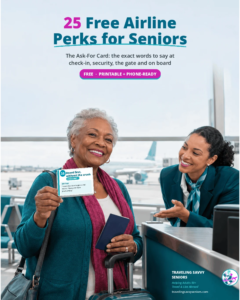
I put everything in this post, and more, into Flying After 60: Your Airline Passenger Rights, a plain-English guide with printable checklists and fill-in-the-blank complaint templates, and it comes with my free 25 Free Airline Perks for Seniors: The Ask-For Cards. [Your Airline Passenger Rights]
I made it because I got tired of watching seniors accept a voucher when they were owed a refund.
Just want the cards for now? Grab the free Ask-For Cards here. [25 Free Airline Perks Ask-For Cards]

Your turn
Tell me in the comments what happened on your last flight. I’ll reply with the exact phrase to use next time.
Safe travels, Mary
Rules here are for US airlines and flights, checked November 16, 2026. Airline promises can change, so check your airline’s customer service plan before you fly.