For a first trip — or a longer, slower stay — the visa is the one piece of paperwork to settle first. The Vietnam e-visa for US citizens is a single online application, but the form is unforgiving: one wrong letter or date can stop you at the airline check-in desk.
I live in Vung Tau and have lived across Vietnam since January 2025. This is the process as it works today.
The quick answer
Do US citizens need a visa for Vietnam? Yes. Apply online before you fly. Where: Only on the official portals — evisa.gov.vn or thithucdientu.gov.vn. No other site is official. How long: Single-entry or multiple-entry, for up to 90 days. Cost: US$25 single-entry; US$50 multiple-entry, non-refundable whether granted or refused. When: You must be outside Vietnam when you apply, up to a year before travel. In practice, we recommend 3–4 weeks ahead. You will need: Your passport, a recent 4×6 cm photo meeting the rules below, your dates, and a payment card. |
Do US citizens need a visa for Vietnam?
Yes. There is no general visa-free entry for US passport holders, so a Vietnam e-visa for US citizens — approved before you board — is the standard route. Vietnam issues it to citizens of all countries, single-entry or multiple-entry, for up to 90 days.
One exception causes real confusion. Travelers who fly directly to Phu Quoc Island, stay on the island, and leave from there can visit visa-free for up to 30 days. That exception does not cover the mainland: if your trip includes Ho Chi Minh City, Da Nang, Hanoi, or anywhere else — or a mainland connection on the way to the island — you need the e-visa.
Before you start: gather these first
The application goes more smoothly on a computer or tablet than on a phone — a larger screen makes checking details easier. Before you open the portal, have these ready:
- Your passport, open to the data page. The e-visa cannot exceed 90 days and must end at least 30 days before your passport expires — so travel with about six months of validity left.
- A clear image of the passport data page, and a recent portrait photo, 4×6 cm, JPG or JPEG under 2 MB: front-facing, no hat, no glasses, formal attire, white background.
- Your dates and entry point. Your landing date, your planned leaving date, and your entry airport or border gate. Read the date-line section below before choosing that first date.
- Your first address in Vietnam. If you will stay at several addresses, declare the first one.
- An email address you can open while you travel, including any two-factor codes. Your approval and status checks depend on it.
- A payment card or banking app. Card payments can require a one-time bank code, so keep your phone nearby.
Each traveler needs their own application — a spouse is not covered by yours: two applications, two fees, two approvals to print.
How to apply for a Vietnam e-visa for US citizens, step by step
Start on one of the two official sites, evisa.gov.vn or thithucdientu.gov.vn, and nowhere else. Lookalike sites charge unauthorized extra fees. If a page is not on a .gov.vn address, close it.
- Upload the two images. The system checks both automatically and will not let you submit if an image is invalid, so fix a flagged photo now.
- Complete the declaration in English. It must be complete and accurate — dishonest information means denial. Enter your full name, including your middle name, in uppercase, exactly as on the ICAO line of your passport data page.
- Stop at the confirmation step and check everything — name, passport number, date of birth, dates, and entry gate. This is your last easy chance to catch a typo.
- Enter the verification code and pay online by card, QR code, or banking.
- Wait for the payment confirmation. Status can take up to two hours to update. Check before paying again — a second paid application counts as separate, with no refund of the first fee.
- Check your result later on the portal using your electronic profile ID, date of birth, and email. Save that ID somewhere safe.
On timing, honestly: the portal promises no turnaround. In practice, allow at least 3–5 Vietnamese working days — a US Friday application is already the weekend there. Applying 3–4 weeks ahead keeps a typo from becoming an emergency.
The date-line trap: land date, not departure date
This mistake catches Americans specifically. The entry date on your application must be the date you land in Vietnam — not the date you leave the United States.
Flights to Vietnam cross the International Date Line. Leave Los Angeles on a Friday evening, and you land in Ho Chi Minh City on Sunday — and your e-visa must start on Sunday, not on your Friday departure day. You cannot enter before the start date on your approval.
The habit that prevents it: take the date from the “arrives” line of the Vietnam flight segment on your booking, and check it against the application before you pay.
Mistakes that stop seniors at check-in
Airlines check your e-visa before you board, so problems surface at a US check-in desk, under time pressure. Rule these out at home:
- A name that does not match the passport. A missing middle name, or a different order than the ICAO line, is the most common error. Copy it character for character.
- A wrong passport number. Read it back slowly, digit by digit — the letter O and the number 0 look alike in a hurry.
- A photo that fails the rules. Glasses on, a hat on, a colored background, or a file that is not JPG/JPEG under 2 MB.
- The wrong entry point. Entry and exit are only through designated gates on the official list — 81 in total: 15 airports, including Noi Bai, Tan Son Nhat, Da Nang, Cam Ranh, and Phu Quoc, plus 27 land gates and 39 seaports. Enter through the gate you declared.
- Arriving before the start date. Worth repeating: a day early is arriving without a visa.
- Paying twice. If a payment looks stuck, wait and check the status first. Duplicate payments are not refunded.
Single-entry or multiple-entry?
Ask one question: will you leave Vietnam and come back on this same trip? A side trip to Cambodia or Thailand and back means multiple-entry, chosen when you apply — it cannot be added later. Vietnam only? Single-entry at US$25 does the job.
The 90-day reality
- You must enter within your visa’s validity window — the dates on the approval, not a suggestion.
- There’s no official self-service extension. The portal offers no extension route. Some local agencies advertise extensions for a fee, but results aren’t guaranteed, so don’t build a plan around one. Staying longer is most reliably done by leaving Vietnam and applying for a new e-visa from outside the country.
- You do not have to exit through the same gate you entered. Both must be designated gates, but they can differ.
- The e-visa cannot be used for work. It is for visiting, not employment.
Arrival day: what actually happens
Landing with an e-visa is simpler than the old process. There is no visa counter to find and no cash stamping fee on arrival — you go straight to immigration with your passport and printed approval.
Print two copies of the approval before you leave home. Keep one with your passport in hand luggage — never in checked bags — and the second separately.
Before you walk away, check the entry stamp in your passport. The stamped exit date governs your stay, and the counter is the easiest place to question it.
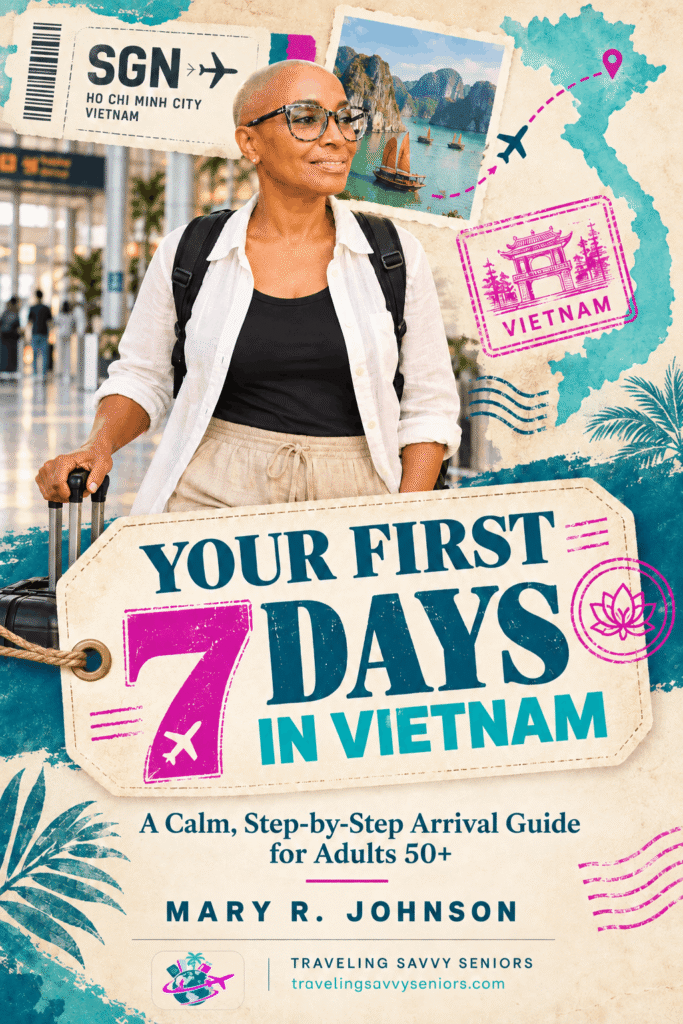
Three comfort decisions help: book wheelchair or airport assistance in advance if a long queue is a concern; avoid tight same-day onward connections; and arrange your first night’s address and transfer before you land. Landing at Tan Son Nhat? Our Ho Chi Minh City for seniors guide covers that airport and city, and Your First 7 Days in Vietnam plans the week that follows.
The senior safety net
- Insurance matching your actual dates. Medicare generally will not pay for care in Vietnam. Arrange travel medical and evacuation coverage for your full stay. Learn more about SafetyWing Travel Insurance. Be sure to check their age and pre-existing condition exclusions. SafetyWing is an affiliate. As an Ambassador, I may earn from qualifying purchases.
- Medications for the whole trip, plus a buffer. Carry them in original packaging, in hand luggage, with a written prescription list.
- Copies in two places. Save your profile ID and approval PDF on your phone and in email, and leave copies with family at home, in case a phone is lost or runs flat.
What the e-visa is not
It is not a residence permit, and not VNeID, Vietnam’s electronic identification system — a separate topic, relevant only after you arrive, covered in Vietnam VNeID for Foreigners: What You Need to Know in 2026. It is not a guarantee of entry, and not a substitute for a valid passport or insurance. It is permission to arrive, for the dates and entry point it names.
Frequently asked questions
Do US citizens need a visa for Vietnam?
Yes — no general visa-free entry for US passport holders, so apply online before you fly. The exception is a direct Phu Quoc trip (in, on the island, out from there): up to 30 days, mainland not covered. One more exception: if you were born in Vietnam, or are the spouse or child of someone who was, you may qualify for a 5-year visa exemption certificate instead. Contact the Vietnamese embassy or a consulate for details.
How long can Americans stay in Vietnam?
Up to 90 days, single- or multiple-entry, within the dates on your approval. Enter on or after the start date; your arrival stamp sets your leaving date.
How much does a Vietnam e-visa cost?
US$25 single-entry; US$50 multiple-entry, paid on the official portal. The fee is non-refundable, granted or refused.
How long does a Vietnam e-visa take?
The portal promises no turnaround. In practice, allow 3–5 Vietnamese working days; we recommend applying 3–4 weeks ahead.
Can I extend my Vietnam e-visa?
There’s no official self-service route. Agencies advertise extensions, but they aren’t guaranteed. The reliable way to stay longer is to leave Vietnam and apply for a new e-visa from outside.
Is there a visa on arrival in Vietnam?
No walk-up option. The e-visa, approved before you fly, is the standard route — no visa counter and no cash stamping fee at the airport.
Do I need to print my e-visa?
Yes — two copies: one with your passport in hand luggage, one kept separately. Airlines check it before boarding.
What if I make a mistake on my application?
Check everything at the confirmation step, before paying — mistakes are free to fix there. Afterwards, check your status with your profile ID and contact immigration (hotline +84 24 3825 7941; email foreigners@xuatnhapcanh.gov.vn) before paying again; some errors mean a new application.
What if I renewed my passport after my e-visa was approved?
A new passport means a new application — the e-visa is tied to the old passport number. Renew first, then apply.
Can I enter Vietnam before my e-visa start date?
No. Entry before the start date is not allowed, so the landing date on the application has to be right.
Get ready for arrival, not just the visa.
If you land at Tan Son Nhat (Ho Chi Minh City), complete the free Digital Arrival Card at prearrival.immigration.gov.vn within 72 hours before landing, and save the QR code. It doesn’t replace your e-visa. It’s being rolled out to other airports, so check before you fly. The e-visa gets you to the immigration counter. Our free Vietnam Pre-Arrival Checklist covers the rest of a smooth arrival — the e-visa, the digital arrival card, and your first steps at the airport — in the right order. |
Rules checked October 23, 2026, against the official portals. If your trip is months away, re-confirm on evisa.gov.vn before applying.