Why Slow Travel After 50 Requires a Different Kind of Destination Planning
Slow travel after 50 works best when the destination supports your real pace, not just your travel dreams. Walkability, transportation, medical access, rest days, terrain, and neighborhood comfort all matter more than they may have in earlier seasons of life.
Slow travel after 50 is not about seeing less — it is about choosing destinations that fit your pace, comfort level, mobility needs, and long-stay travel goals.
Some travelers can walk — just not all day.
They can stroll through a beautiful neighborhood, enjoy a waterfront promenade, visit a museum, browse a local market, and sit at a café watching daily life unfold. But they may not want to climb endless stairs, walk for hours on uneven sidewalks, rush through three attractions before lunch, or get stranded far from their hotel when their energy runs out.
That is the traveler this guide is written for.
At Traveling Savvy Seniors, we believe travel after 50 should not feel like an endurance test. A beautiful destination matters, of course. But so does the reality of how your body feels when you are there. The best slow travel destinations for older adults are not always the trendiest or the cheapest. They are the places where you can enjoy the experience at a comfortable pace, find places to rest, get around without too much stress, and feel supported if your mobility, stamina, or confidence is not what it used to be.
This guide focuses on destinations that may work well for older adults who can walk, but not far — including travelers with knee pain, arthritis, balance concerns, fatigue, heat sensitivity, breathing limitations, or simply a desire to slow down and enjoy the trip without pushing too hard.
This is not a medical or accessibility certification guide. Every traveler’s needs are different. But it is a thoughtful starting point for choosing places that may offer a better fit for adults 50+ who want beauty, culture, comfort, and a slower rhythm.
Jump to a Section
- What “Mobility-Friendly” Really Means After 50
- The TSS Mobility Reality Check
- A Note on Heat: The Hidden Energy Drain
- 10 Destinations to Consider
- Destinations at a Glance
- When You and Your Travel Companion Move at Different Speeds
- Practical Tools Before You Go
- Planning Tips for Travelers Who Can Walk, But Not Far
- The Best Slow Travel Destination Is the One That Fits Your Real Life
What "Mobility-Friendly" Really Means After 50
When people hear the phrase “accessible travel,” they often think only of wheelchair ramps, accessible bathrooms, and fully wheelchair-adapted transportation. Those things are extremely important, but there is also a large group of travelers who live in the middle.
They may not use a wheelchair. They may not need full-time assistance. They may even look perfectly mobile to other people.
But they know their limits.
They know that stairs can change the entire day. They know that cobblestones can be exhausting. They know that heat can drain their energy faster than expected. They know that a hotel “only ten minutes from town” may feel very different if that walk is uphill, uneven, or poorly lit. They know that being able to sit down, take a taxi back, find a clean bathroom, or return to their lodging easily can make the difference between a joyful trip and a stressful one.
For this guide, mobility-friendly means a destination may offer some combination of:
- Reliable taxis, ride-share, or public transportation
- Flatter areas or easier walking routes
- Benches, cafés, parks, or places to rest
- Hotels with elevators or ground-floor options
- Nearby pharmacies or healthcare access
- A slower daily rhythm
- Shorter distances between essentials
- Comfortable neighborhoods where you do not have to “do everything”
- Enough beauty and interest that you can enjoy the place without constant movement
That last point matters.
A good slow travel destination should still feel rewarding even if you skip the big tour, take a rest day, sit by the water, or spend the morning in one neighborhood instead of racing across town.
The TSS Mobility Reality Check
For this article, I am using what I call the TSS Mobility Reality Check. It is not a formal accessibility rating. It is a practical way to think through how a destination may feel for adults 50+ who want to travel realistically.
Each destination below is considered through these questions:
- Can you enjoy the destination without walking for hours every day?
- Are there flatter areas, promenades, parks, or central neighborhoods?
- Are taxis, ride-share, or public transportation easy enough to use?
- Are there hotels or rentals with elevators or ground-floor options?
- Is the climate likely to drain your energy?
- Can you find places to sit, rest, eat, and reset?
- Is healthcare or pharmacy access reasonably nearby?
- Can you return to your lodging easily when you get tired?
- Does the destination work for slow travel, not just sightseeing?
The goal is not to find perfect places. Perfect rarely exists.
The goal is to find places where a traveler can make thoughtful choices, pace the trip well, and still feel like the destination is working with them — not against them.
A Note on Heat: The Hidden Energy Drain
Several destinations in this guide are warm or hot for much of the year. That is worth addressing directly, because heat is one of the most underestimated challenges for older travelers — especially those managing health conditions or taking medications.
Many common medications for blood pressure, heart conditions, diabetes, diuretics, and antihistamines can increase sensitivity to heat and make it harder for your body to regulate temperature. If you are in that category, it is worth talking to your doctor before a trip to a hot climate, not to be discouraged from going, but so you can plan wisely.
Practical heat management strategies that work:
- Time your outings carefully. The coolest parts of the day are typically before 10 a.m. and after 4 p.m. Plan your outdoor activities around those windows.
- Build in air-conditioned breaks. Malls, museums, cafés, and hotel lobbies are not just conveniences — they are recovery stations. Use them without guilt.
- Stay hydrated, but also replace electrolytes. Water alone is not always enough in high heat. Sports drinks, coconut water, or electrolyte tablets can help.
- Know the warning signs of heat exhaustion. Heavy sweating, weakness, dizziness, nausea, and headache are signals to stop, get inside, and cool down. Heat stroke — confusion, hot dry skin, rapid pulse — is a medical emergency.
- Dress strategically. Loose, light-colored, breathable fabrics make a real difference.
- Use Grab or a taxi for midday errands. There is no reason to walk through peak heat when a short ride costs very little.
- Choose air-conditioned lodging. This is not a luxury in a tropical climate. It is a health consideration.
The heat notes in each destination section below are written with this in mind.
The 10 Destinations
1. Taipei, Taiwan
Taipei is one of the strongest cities to consider if you want an international destination with urban convenience, food culture, public transportation, and a slower travel rhythm that can be shaped around neighborhoods.
For adults who can walk but not far, Taipei works well because so much of daily life is concentrated. You can spend a morning in one neighborhood — a café, a temple, a market, a park bench — without needing to cover large distances. The city also has an official accessible tourism section that highlights ramps, elevators, handrails, and accessible toilets at selected sites, along with accessible taxis, rail, and tourist shuttle options.
Best for: Urban slow travelers, food lovers, culture seekers, and those who want a modern Asian city with strong infrastructure.
Best time to visit: October through December tends to offer the most comfortable temperatures and lower humidity. Spring (March–April) can also be pleasant. Avoid July through September if heat and typhoon season are a concern.
Mobility reality: Taipei may be easier than many older Asian cities, especially around transit and major public sites. But the real-life experience for someone with knee pain or fatigue depends heavily on neighborhood and hotel choice. A café-heavy, flat neighborhood near an MRT station feels very different from navigating a crowded night market on an uneven side street.
What to watch for: Crowded transit stations, language differences, and micro-terrain. The MRT system is excellent but can involve long underground corridors and escalator-only situations in some stations. Staying close to an MRT station, pharmacy, and cafés can make a significant day-to-day difference.
Slow travel verdict: Taipei is a strong option for older travelers who want Asia with good infrastructure. It works best approached neighborhood by neighborhood, at your own pace, rather than as a rush-around city.
2. Singapore
Singapore is one of the easiest international cities to recommend for travelers who want organization, cleanliness, English-language ease, and strong public infrastructure. It is not the cheapest destination, and the heat is very real, but for mobility-conscious travelers, the planning environment is more predictable than in many other places.
All public buses and trains are wheelchair accessible, with barrier-free access routes at train stations and bus interchanges. Most bus stops are accessible, and bus stop seating is designed with elderly commuters in mind. For someone who can walk but not far, Singapore’s infrastructure means you can rely on public transit and short connections without a lot of guesswork.
Best for: First-time Asia travelers, older adults who want a soft landing, travelers who value order and clean public spaces, and those who need English widely spoken.
Best time to visit: Singapore is hot and humid year-round, so there is no truly cool season. February and the early months of the year tend to be slightly drier. Whatever time you visit, plan your days around indoor breaks and early-morning or late-afternoon outings.
Mobility reality: Singapore’s infrastructure is a major advantage. Malls, airports, transit stations, gardens, and waterfronts tend to be easier to navigate than in many destinations. The challenge is not infrastructure but endurance in the heat. Even a short walk between transit stops can feel more draining than expected in tropical conditions.
What to watch for: Heat is the primary concern. Build every day around early mornings, late afternoons, taxis when needed, and plenty of air-conditioned recovery time. Even strong, healthy travelers find the humidity tiring.
Slow travel verdict: Singapore is excellent for comfort and ease, especially for a first international trip or a short slow-travel stay. The main drawback is cost, so it may work better as a shorter base than a long budget stay.
3. Kuala Lumpur, Malaysia
Kuala Lumpur can be a helpful destination for older adults who want Southeast Asia with city comforts, international food, private transportation options, modern malls, hospitals, and an affordable lifestyle compared with many Western cities.
For travelers who can walk but not far, the biggest advantage is that you do not have to rely on walking at all. Grab (the region’s dominant ride-hailing app) is reliable, affordable, and easy to use from your phone. Much of daily life can be built around cafés, malls, medical centers, serviced apartments, and restaurants without covering significant ground on foot.
Best for: Budget-conscious travelers who still want comfort, private transportation, good food, mall access, and easy healthcare.
Best time to visit: Malaysia has a tropical climate with rain year-round, but the drier season in Kuala Lumpur generally runs from May through July and again in January through February. Avoid the heaviest monsoon months (October through December on the west coast) if rain sensitivity is a concern.
Mobility reality: Kuala Lumpur is not a city where I would suggest wandering randomly for hours. Sidewalks vary in quality, distances between areas can be spread out, and the city feels car-oriented in parts. With the right base and consistent use of Grab, however, it can be very manageable for slow travelers. The key word is base.
What to watch for: Neighborhood choice matters enormously here. Being near cafés, a mall, restaurants, and pharmacies counts for more than being near a tourist site. Some train stations lack elevators — always confirm elevator access before booking lodging, and confirm the building entrance is step-free.
Slow travel verdict: Kuala Lumpur works well for older slow travelers who are comfortable using ride-share instead of relying on walking. It is less about strolling everywhere and more about choosing a comfortable base and moving intentionally.
4. Penang, Malaysia
Penang, especially George Town and surrounding areas, is often attractive to older travelers because of its food, cultural mix, slower rhythm, waterfront areas, medical tourism reputation, and long-stay appeal. It can feel more relaxed than Kuala Lumpur while still offering city conveniences.
For travelers who can walk but not far, Penang can be rewarding if planned carefully. You can build gentle days around cafés, heritage streets, food courts, waterfront views, temples, and short taxi rides. The rhythm of the city is softer than a major capital, and the food culture means there is almost always a good reason to sit down.
Best for: Food lovers, cultural slow travelers, long-stay explorers, and adults 50+ who want a softer city rhythm with international comforts.
Best time to visit: The drier and slightly cooler months (December through February) tend to be the most comfortable. The northeast monsoon brings heavier rain to Penang from October through January, though it is usually manageable and short-lived. Avoid the hottest months (April–May) if heat is a significant concern for you.
Mobility reality: Penang can be very enjoyable at a slow pace, but it is not automatically easy. Older sidewalks in heritage areas can be uneven or blocked by parked motorbikes. Street crossings require attention. The key is staying in an area where food, cafés, and daily needs are within short reach.
What to watch for: Heat, older sidewalks, traffic crossings, and hotel access. Always check whether your lodging has elevators, easy entrance access, and nearby transportation. A beautiful heritage shophouse may have steep stairs — verify before booking.
Slow travel verdict: Penang may be a good slow travel fit for older adults who want culture, food, and affordability, but it requires realistic planning around heat and walking surfaces.
5. Da Nang, Vietnam
Da Nang is one of Vietnam’s more comfortable cities for older slow travelers because it offers beaches, cafés, riverfront areas, international food, modern apartments, a growing expat community, and a less overwhelming pace than Hanoi or Ho Chi Minh City.
For adults who can walk but not far, Da Nang may feel more manageable than many Vietnamese cities, especially if you choose a base near My Khe Beach, the river, or a cluster of cafés and restaurants. You can build a routine — coffee in the morning, a beach walk, lunch at a nearby spot, an afternoon rest — without needing to cover the whole city.
Best for: Beach-city slow travel, affordable long stays, cafés, seafood, and adults 50+ who want Vietnam with some modern conveniences.
Best time to visit: February through May is generally the best window — lower rainfall, lower humidity, and warm but not extreme temperatures. Avoid October and November, when Da Nang experiences its heaviest rainfall and occasional flooding. June through August can be very hot.
Mobility reality: Da Nang is easier than many places in Vietnam, but sidewalks, curb cuts, street crossings, and traffic still require attention. Some areas near the beach are flatter and more walkable than others. The best base depends heavily on your comfort level with typical Southeast Asia conditions.
What to watch for: Heat in summer months, motorbike traffic, uneven sidewalks, and street crossings. Use Grab when needed and avoid booking lodging too far from cafés, restaurants, or the beach if walking distance matters to you.
Slow travel verdict: Da Nang is a strong Vietnam option for older slow travelers, especially for longer stays, but it is best for people who are comfortable with some Southeast Asia adjustment.
6. Vung Tau, Vietnam
Vung Tau is a coastal city that may appeal to adults 50+ who want a slower daily rhythm, sea air, cafés, local markets, beach walks, and a quieter alternative to Vietnam’s larger cities. It is not as internationally polished as Da Nang, but that can also be part of its charm.
This is where slow travel matters. Vung Tau is not a place where you need to rush through an itinerary. You can build a gentle routine around coffee, the beach, neighborhood restaurants, local markets, and short Grab rides. For someone who wants to test a slower lifestyle abroad, it may offer a more realistic look at daily life than a highly curated tourist zone.
Best for: Slow beach routines, affordability, local life, café culture, and travelers who want to stay longer rather than rush.
Best time to visit: November through April is the dry season and generally the most comfortable time to visit. May through October brings more rain and higher humidity. December and January can feel almost cool by coastal Vietnam standards and are lovely for beach walking.
Mobility reality: Vung Tau can be very comfortable in the right area, but it is not consistently accessible. Some sidewalks are uneven or partially blocked by parked motorbikes. Traffic patterns take adjustment. A traveler who can walk short distances will enjoy it most by choosing lodging close to cafés, groceries, and the beach — reducing the need for longer walks throughout the day.
What to watch for: Sidewalk quality, traffic crossings, heat in the wet season, and distance from daily services. Do not choose lodging based only on appearance or price. Location to daily life matters more than almost anything else.
Slow travel verdict: Vung Tau can be a beautiful slow travel base for independent older travelers, especially those open to Vietnam’s daily rhythm. It is not ideal for travelers who need highly predictable accessibility unless lodging and transportation are carefully planned in advance.
7. Ljubljana, Slovenia
Ljubljana is a lovely option for travelers who want Europe without the scale and intensity of major capitals like Paris, Rome, or London. It offers charm, culture, riverside cafés, green spaces, and a smaller-city feel that makes slow travel genuinely easier.
Ljubljana’s tourism site describes the city as wheelchair-friendly, noting that almost every part of the city can be accessed without stairs if you avoid the castle hill. For someone who can walk but not far, a flat city center with compact distances between cafés, restaurants, and cultural sites is a meaningful advantage. You can cover a lot of ground in a short walk and still feel like you saw something beautiful.
Best for: Older travelers who want a smaller European capital, café culture, scenic walking areas, and less overwhelm.
Best time to visit: May through September offers the warmest and most pleasant conditions. June and September are particularly nice — warm without being oppressively hot, and less crowded than peak July and August. Winter is cold and can be wet or icy, which adds difficulty for anyone with balance concerns.
Mobility reality: Ljubljana can be a strong fit for slow travel because it is compact and genuinely scenic. That said, as with many European destinations, some surfaces, older buildings, and specific hotel access need checking before you book. The flatter riverside area is your friend.
What to watch for: Cobblestones or uneven surfaces in some areas, hills outside the flatter center, winter ice, and lodging access in older buildings. Ask directly about entrance steps and elevators when booking.
Slow travel verdict: Ljubljana is one of the better European-style options for travelers who want beauty and culture without feeling swallowed by a massive city.
8. Munich, Germany
Munich can work well for older adults who want strong infrastructure, parks, museums, public transportation, healthcare access, and a polished urban environment. It is not a budget destination, but it offers predictability — and predictability is genuinely valuable when you are managing your mobility carefully.
Much of Munich’s public transportation system is accessible, with many metro stations offering elevators, though travelers are advised to verify elevator status at specific stations before relying on them. Germany broadly promotes barrier-free travel across transportation, accommodations, and attractions.
Best for: Travelers who want Europe with strong infrastructure, museums, parks, organized transit, and high-quality services.
Best time to visit: May through September is the most pleasant for outdoor enjoyment. June and early September are ideal — warm but not extreme, and the city feels lively. Avoid October if you are sensitive to large crowds; Oktoberfest brings an intense spike in visitors. Winter is cold and requires extra care on icy surfaces.
Mobility reality: Munich can be easier than many historic European cities, especially when using transit and planning around central areas. It still requires checking hotel access, transit elevator availability, and walking distances between stops.
What to watch for: Cost, seasonal weather, and the need to verify elevator access at stations and accommodations. Even in a well-designed city, a broken elevator at your transit station can change your whole day.
Slow travel verdict: Munich is a good choice for travelers who want a comfortable, structured European city experience and do not mind paying more for ease and predictability.
9. Zaragoza, Spain
Spain is often on the wish list for older travelers, but most people immediately think of Barcelona, Madrid, Seville, or Valencia. Zaragoza deserves serious attention because it may offer a less overwhelming Spanish city experience with real accessibility momentum behind it.
Zaragoza was awarded the European Commission’s 2026 Access City Award for its efforts to make the city more accessible for people with disabilities. The city’s tourism office also provides information on accessible services, including tourist offices with ramps, adapted counters, accessibility kits, Braille materials, and information on accessible monuments and spaces. This is not just marketing — it reflects genuine institutional investment.
Best for: Travelers who want Spain beyond the obvious cities, cultural richness, a less crowded feel, and a destination that is actively working on accessibility.
Best time to visit: Spring (April–May) and fall (September–October) offer the most pleasant temperatures. Summer in Zaragoza can be very hot — it sits in an inland valley and can reach extreme highs in July and August, so if heat is a concern, plan around the shoulder seasons.
Mobility reality: Zaragoza may be one of the more promising options in Europe for older travelers who want a Spanish city with practical accessibility efforts. Still, as with all European cities, older buildings, surface conditions, hotel elevator access, and neighborhood choice all need checking.
What to watch for: Confirm lodging access and elevator availability. Check whether your planned attractions match your mobility needs. Avoid summer heat if it is a factor for you.
Slow travel verdict: Zaragoza is one to watch. It could be a very strong fit for older travelers who want Spain with less overwhelm and more accessibility attention than many travelers expect from a mid-size Spanish city.
10. San Diego, California
Not every slow travel destination after 50 needs to be abroad. For some travelers, a domestic destination is the right first step — especially if international travel feels intimidating, health concerns make a long flight less appealing, or you simply want to test the rhythm of slow travel before committing to an overseas trip.
San Diego offers beaches, waterfront areas, gardens, museums, and neighborhoods with a familiar travel environment for U.S. travelers. The San Diego Tourism Authority provides accessibility resources, including free beach wheelchairs available at several beaches. California also promotes accessible travel for visitors with mobility needs, sensory sensitivity, and non-visible disabilities.
Best for: U.S.-based travelers who want an easier slow travel experience, beach access, good weather, and fewer international logistics.
Best time to visit: San Diego is one of the most consistently pleasant climates in the country. May through October is warm and mostly sunny. June can bring morning coastal fog (“June gloom”), which some people love. There is no bad season, but spring and fall tend to offer the best combination of warmth and manageable crowds.
Mobility reality: San Diego can be a strong choice if you select your base well. Waterfront areas, beach communities, parks, and hotels near the water can work nicely for slower-paced trips. The city is very spread out, however — transportation planning matters more than in a compact European city.
What to watch for: Cost, traffic, and choosing lodging close to the kind of experience you want. A poorly located hotel can make the trip much harder, requiring a car or rideshare for everything.
Slow travel verdict: San Diego is a strong domestic option for travelers who want beauty, good weather, and more predictable accessibility without leaving the United States. It is also a useful “practice run” destination before taking the leap to international slow travel.
Destinations at a Glance
| Destination | Best for | Heat concern | Best season | Main watch-out |
|---|---|---|---|---|
| Taipei, Taiwan | Urban slow travel, food, culture | Moderate–High | Oct–Dec, Mar–Apr | Crowds, station navigation, neighborhood choice |
| Singapore | First-time Asia, comfort, English | High year-round | Feb (slightly drier) | Heat and humidity; cost |
| Kuala Lumpur, Malaysia | Budget comfort, Grab-based living | High year-round | May–Jul, Jan–Feb | Sidewalk quality; neighborhood choice |
| Penang, Malaysia | Food, culture, long stays | High year-round | Dec–Feb | Heritage sidewalks; hotel stairs |
| Da Nang, Vietnam | Beach city, Vietnam with ease | High (summer extreme) | Feb–May | Traffic, uneven sidewalks |
| Vung Tau, Vietnam | Slow beach routine, local life | Moderate–High | Nov–Apr | Sidewalks; distance from services |
| Ljubljana, Slovenia | Compact Europe, café culture | Low–Moderate | May–Jun, Sep | Cobblestones; winter ice |
| Munich, Germany | Infrastructure, museums, parks | Low–Moderate | May–Jun, Sep | Cost; elevator verification |
| Zaragoza, Spain | Spain with less overwhelm | Moderate–High | Apr–May, Sep–Oct | Summer heat; building access |
| San Diego, California | Domestic, beach, easy logistics | Low–Moderate | May–Oct | City is spread out; cost |
When You and Your Travel Companion Move at Different Speeds
This is one of the most common — and least talked about — challenges in travel after 50.
One partner may be comfortable walking several miles. The other may need to stop after twenty minutes. One may be fine on stairs. The other finds them genuinely difficult. One may recover quickly from a long transit day. The other needs two days of rest before they feel like themselves again.
This does not make either person wrong. It does make trip planning more complex, and it can add emotional weight that neither person anticipated.
A few things that help:
Plan each day around the lower-energy person’s capacity — not as a compromise, but as the framework. When the more mobile person builds in rest stops, shorter distances, and slower days, both people tend to enjoy the trip more.
Name it early. Having a conversation before you travel about what each person genuinely needs — not what they think they should be able to handle — avoids resentment mid-trip.
Build in independent time. The higher-energy traveler can take a longer walk, visit an extra museum, or explore a market while the other rests. This is not abandonment. It is smart pacing.
Choose lodging that supports rest. A base with a comfortable chair, a good bed, a nearby café, and easy return logistics means that the person who needs downtime is not stuck in an inconvenient place.
Give each other permission to use transportation. Taxis, Grab, and public transit are not signs of failure. They are tools. Use them.
If you are traveling solo and managing your own pace, this section still applies — to the internal negotiation between the part of you that wants to see everything and the part that knows your body’s actual limits.
Why Slow Travel After 50 Requires a Different Kind of Destination Planning:
Practical Tools Before You Go
Request Airport Wheelchair Assistance — Even If You Do Not Use a Wheelchair
This is one of the most underused, most helpful, and most free services available to older travelers.
Airport wheelchair assistance is not only for people who cannot walk at all. It is for anyone who finds long airport corridors, security lines, boarding gates, and luggage retrieval genuinely tiring or painful — which includes a large number of travelers who are perfectly capable of walking once they reach the destination.
You can request this assistance when booking your flight, through the airline’s website after booking, or by calling the airline directly. At the airport, staff will meet you at check-in or the departure area, escort you through security, bring you to the gate, and assist with boarding. On arrival, you will be met at the aircraft door and taken through immigration and baggage claim.
You do not need a doctor’s note. You do not need to justify the request. It is a service, and it exists for travelers like you.
Rent Mobility Aids at Your Destination — You Do Not Have to Travel With Them
Canes, rollators, transport wheelchairs, and even mobility scooters can often be rented in popular travel destinations. You do not have to pack and carry your own equipment if that adds difficulty to the journey.
Rental options vary by city, so research in advance. Hotel concierges, medical supply companies, and some travel agencies at the destination can help arrange rentals. Traveling Savvy Seniors can also help you identify rental options in your destination as part of our Boots on the Ground service.

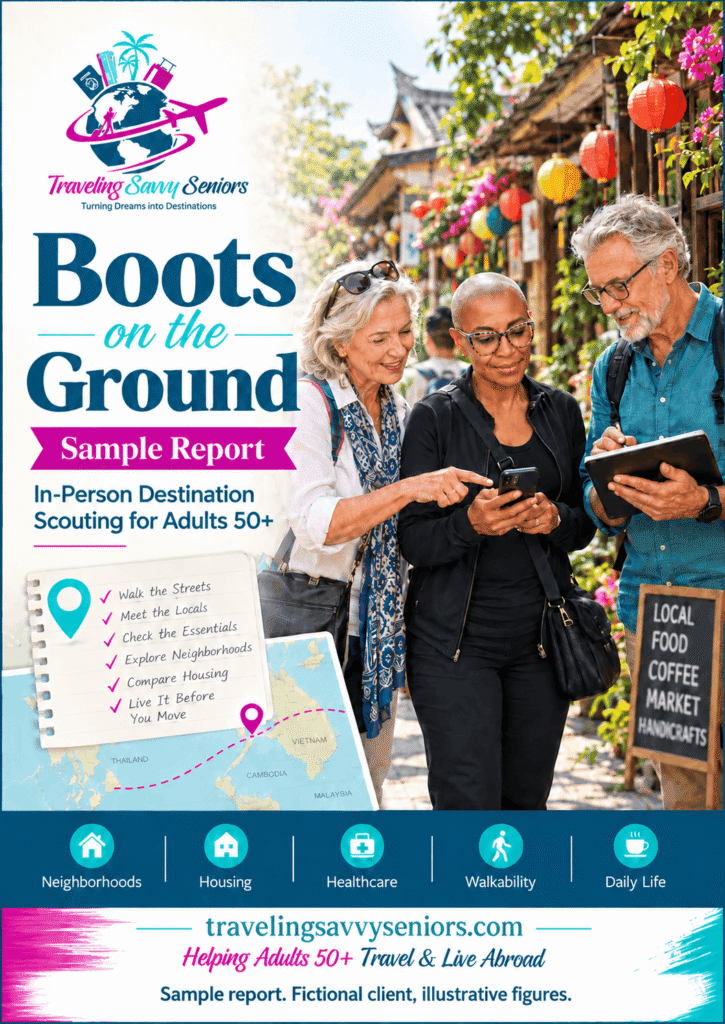
A destination may look perfect online, but the real test is how it feels once you’re there. Boots on the Ground helps adults 50+ understand walkability, transportation, neighborhood comfort, and daily-life details before making a bigger travel or living-abroad decision.
Travel Insurance for Pre-Existing Conditions
This is not optional for travelers 50+ — especially in international destinations.
Standard travel insurance often excludes or limits coverage for pre-existing conditions. If you have a health history, you need a policy that explicitly covers you. Look for policies with strong emergency medical coverage, medical evacuation, and trip interruption protection.
Providers worth investigating for travelers 50+ include SafetyWing Nomad Insurance, Cigna Global, and Allianz Care. Each has different terms, so read the policy details and compare carefully before purchasing.
Communicating Your Needs in Non-English-Speaking Countries
Language barriers can make simple requests — a ground-floor room, help with stairs, a clean bathroom, a place to sit — unexpectedly stressful. A few strategies that help:
- Use Google Translate or DeepL. Download the offline language pack before you travel so it works without Wi-Fi.
- Prepare a printed card. A simple card in the local language that says something like “I have difficulty with stairs — do you have a lift or ground-floor option?” can save a lot of awkward back-and-forth at a hotel reception desk.
- Ask your hotel before arrival. If you have specific access needs, email or message the property in advance and confirm in writing. Do not assume photos or booking descriptions cover what you need to know.
- Use your hotel concierge as a resource. In most destinations, a concierge can help arrange transportation, communicate your needs to restaurants or sites, and answer practical questions that are hard to navigate yourself.
Planning Tips for Travelers Who Can Walk, But Not Far
Choose Your Neighborhood Before Your Hotel
A beautiful hotel in the wrong location can make every day harder. Before you search for accommodation, identify the neighborhood that puts you close to what matters: cafés, restaurants, pharmacies, a waterfront, a market, or a transit stop. Then search for lodging within that neighborhood.
“Ten minutes from the city center” means very different things depending on whether that walk is flat or hilly, shaded or exposed, paved or cobbled, and whether you are fresh or tired.
Ask the Right Questions Before You Book
Do not rely only on photos or booking descriptions. Contact the property directly and ask specifically:
- Is there an elevator? What floor is my room on?
- Are there steps at the entrance to the building?
- How far is it to the nearest café or restaurant on foot?
- Is there step-free access from the street to the lobby?
- Is the bathroom a walk-in shower or a tub step-over?
- Is parking or a taxi drop-off easy at the entrance?
Properties that answer these questions clearly and quickly are usually more reliable than those that deflect or respond with vague reassurances.
Do Not Assume “Walkable” Means Easy
A neighborhood can be walkable for a 30-year-old and genuinely exhausting for someone with knee pain, balance concerns, or heat sensitivity. Read reviews from older travelers specifically. Look for phrases like “easy to get around,” “everything close by,” and “flat neighborhood.” Look for any mention of stairs, hills, or uneven streets.
Plan One Main Activity Per Day
Slow travel works because it leaves room for rest. One museum, one neighborhood, one market, or one scenic walk may be enough — and often is the richer experience.
Two light activities with rest in between is better than four activities you have to push through. Give yourself permission to stop when the day is good rather than when you are depleted.
Use Taxis and Ride-Share Without Guilt
Using transportation is not failure. It is smart pacing. In cities with Grab (most of Southeast Asia), a short ride is cheap, air-conditioned, and available within minutes. In European cities, short taxis or transit rides between neighborhoods are normal. Using them to protect your energy for what matters is good planning.
Build In Arrival Recovery Time
The first 24 to 48 hours after arrival should be gentle. Long flights, jet lag, luggage, immigration, and airport transfers take more out of you than expected. Give yourself a slow first day — rest, eat something good, orient yourself. You will enjoy the rest of the trip more if you do not start it depleted.
Choose Destinations Where Ordinary Days Feel Good
If you are slow traveling, you need more than attractions. You need a place where a regular Tuesday — coffee, a short walk, a good meal, sitting somewhere pleasant — feels satisfying. That is what makes slow travel sustainable and healing.
The Best Slow Travel Destination Is the One That Fits Your Real Life
After 50, travel changes — but that does not mean it gets smaller.
It can become richer. More intentional. More honest. More healing. More aligned with who you are now.
You do not have to prove anything by walking farther than your body wants to walk. You do not have to keep up with an itinerary designed for someone else. You do not have to climb every viewpoint, visit every landmark, or turn every trip into a checklist.
The right destination allows you to experience beauty without exhaustion. It gives you space to rest. It lets you move at your own pace. It respects the body you have now, not the body you had twenty years ago.
And that is the heart of slow travel after 50.
It is not about doing less because life is smaller. It is about doing less so you can experience more.
Before You Choose, Ask Yourself
- How far can I comfortably walk before I need a break?
- Do I need elevators or ground-floor lodging?
- Do stairs make travel stressful for me?
- Does heat drain my energy quickly?
- Do I need taxis or ride-share to be easily available?
- Would I rather stay near a waterfront, park, market, or central café area?
- How close do I want to be to pharmacies or medical care?
- Do I want a short trip, a one-month stay, or a longer test stay?
- Am I traveling with someone who has different mobility needs than I do?
- Am I trying to vacation, heal, explore, retire abroad, or simply imagine a different life?
Those questions matter more than any destination list.
Continue Exploring
If this guide got you thinking seriously about a destination, the next step is making sure you are prepared before you book anything.
Our Moving Abroad Readiness Guide walks you through the practical groundwork — what to research, what to ask, and what to have in place before you commit to a destination or a stay.
And if you want a deeper look at a specific destination before you go — the real neighborhoods, the practical logistics, the things that only someone who has been there can tell you — the Know Before You Go Report is built for exactly that.


This post may contain affiliate links, which means I may earn a small commission if you make a purchase — at no extra cost to you. I only recommend products and services I genuinely believe in and think you’ll love. Thank you for supporting Traveling Savvy Seniors!