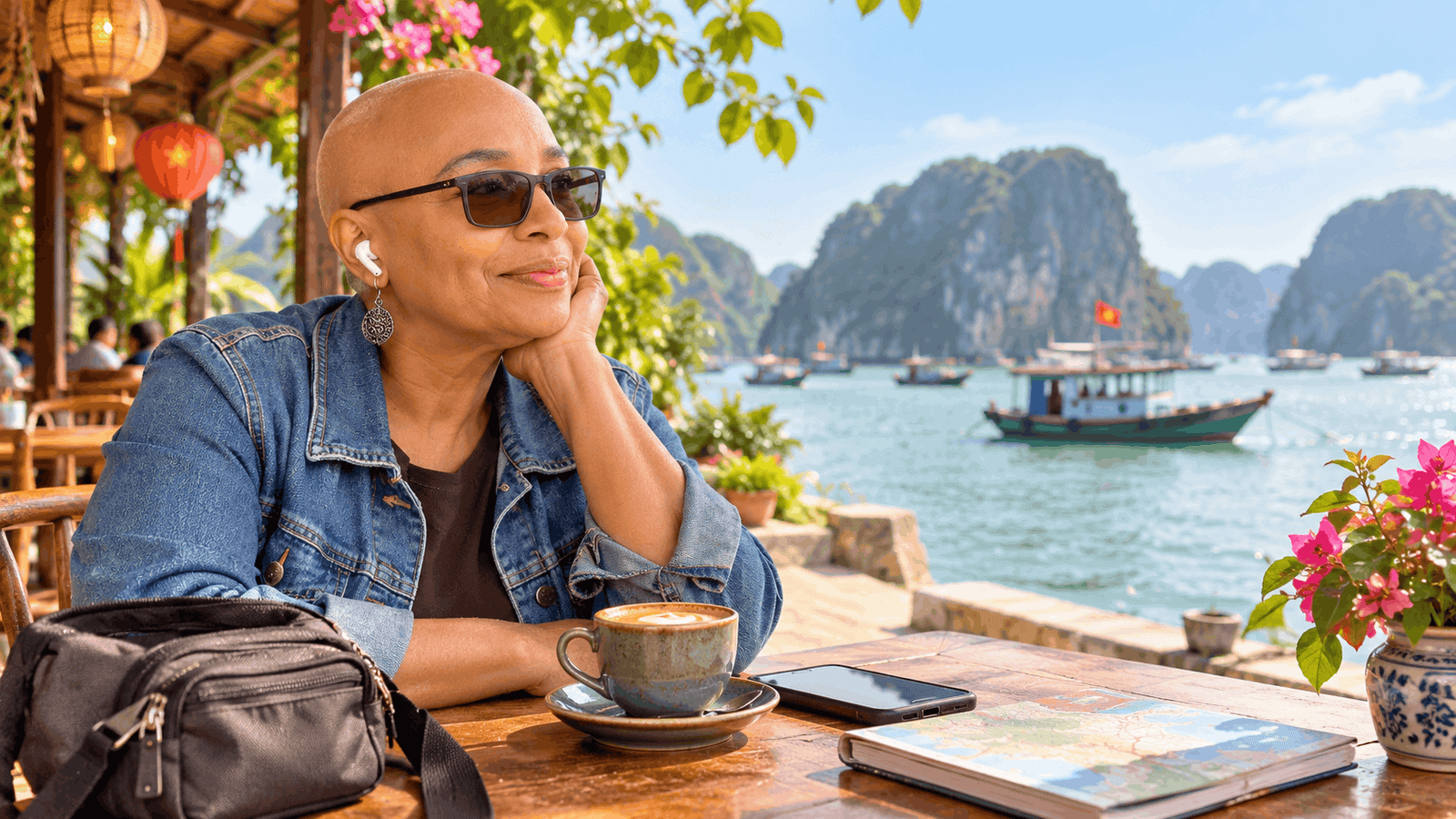
Wondering how to pack for months abroad when you are not just taking a vacation—you are moving your life?
After living across Southeast Asia for more than a year, I can tell you that the answer looks nothing like most of the packing lists you will find online.
Before I left the United States, I had spent decades building a home and accumulating all the things that went with it. Then I packed for Southeast Asia in two bags.
Not because I am a minimalist superhero. Because I had to be.
And here is what surprised me: I do not miss a single thing I left behind. Not one.
If you are preparing for a long-term stay abroad—three months, six months, a year, or longer—this is not another article telling you to bring five tops, three bottoms, and two pairs of shoes.
You have read that article. Everyone has written that article.
This guide is about what actually matters when you will not be returning home anytime soon—and why the biggest packing mistakes often have very little to do with the number of clothes in your suitcase.
If you still want a more traditional item-by-item reference, you can also read my Slow-travel packing list for seniors. This article takes the next step by helping you decide what deserves space in your bags and what does not.
First, Change Your Packing Mindset
Vacation packing and slow-travel packing are completely different problems.
When you are leaving for 10 days, you are packing for a temporary experience. When you are leaving for six months, you are creating a miniature version of your everyday life.
The goal is not to bring enough of everything. The goal is to protect the routines and resources that allow you to remain healthy, comfortable, connected, and independent.
Before placing something in your bag, ask:
- Can I buy this at my destination?
- Can I replace it in the correct size, strength, or formulation?
- Would being without it affect my health, mobility, comfort, or ability to function?
- Would I be upset if it were lost, damaged, or stolen?
- Will I use it often enough to justify carrying it through several airports or cities?
Shampoo? Buy it there. Laundry detergent? Buy it there. Extra towels? Leave them at home.
Your prescription glasses, supportive shoes, hearing-aid charger, CPAP equipment, or exact blood-pressure medication? Those require considerably more thought.
If this will be your first extended international trip, my guide to Traveling abroad for the first time after 50 can also help you think beyond the suitcase and prepare for your arrival.
Pack for Health Continuity, Not Just the Flight
Medication is the one area where there should be no improvising or assuming that you will figure everything out later.
Before leaving, confirm whether every medication you take is legal in each country you plan to enter. A medication routinely prescribed in the United States may be restricted elsewhere, particularly certain pain medications, sedatives, stimulants, sleep aids, and psychiatric drugs.
Do not rely solely on a travel discussion board or another traveler’s experience. Check the destination country’s embassy or health-authority website when possible. The U.S. Department of State also advises travelers to investigate local medication restrictions before departure.
Ask your physician and insurance company how much medication you may receive before leaving. Some insurers offer a vacation override or extended supply, but the amount you are permitted to carry through customs depends on the destination.
If the permitted supply will not cover your entire stay, establish a refill plan before departure. Find out:
- Whether the same medication is sold locally
- Whether it is available in the same dosage
- Whether you will need to see a local doctor
- Whether the medication is sold under a different brand name
- Whether an American prescription will be recognized
- How much an appointment and refill may cost
Carry medication in its original labeled packaging. Bring a printed medication list showing:
- Brand and generic names
- Dosages and instructions
- The reason each medication is prescribed
- Allergies and known reactions
- Your physician’s contact information
Ask your doctor for a signed letter on official letterhead explaining your medical conditions and why the medications are necessary.
A weekly pill organizer can be useful after you arrive, but do not empty several months of medication into an unlabeled container before crossing international borders.
Ask your pharmacist about storage as well. Heat and humidity can affect certain medications, eye drops, insulin, injectables, test strips, and other medical supplies. Find out whether anything must remain refrigerated, what temperature range is safe, and whether you need a medical cooling pouch.
Keep essential medications and medical supplies in your personal item or carry-on—not in checked luggage.
For a more detailed health-preparation plan, read Managing Chronic Conditions While Traveling Abroad.
Do Not Forget Medical Coverage
Packing medications and medical records is important, but you should also know how you would pay for care if something happened abroad.
Original Medicare generally provides very limited coverage outside the United States. Certain Medigap plans offer a restricted foreign emergency benefit, but those benefits have deductibles, time limits, coinsurance, and a lifetime maximum.
Before departure, review:
- International health-insurance coverage
- Travel medical insurance
- Emergency medical evacuation coverage
- Preexisting-condition exclusions
- Age restrictions
- Whether the insurer pays the hospital directly
- Whether you must pay first and request reimbursement later
My article Medicare Won’t Save You Abroad explains the coverage gaps older travelers should understand before committing to a long stay.
Also save the name, address, telephone number, and directions to a suitable hospital or clinic near your first accommodation. You do not want your first search for medical care to happen during an emergency.
Pack What Keeps Your Body Functioning
Medication is only one part of staying well abroad.
Consider anything that would be difficult to replace quickly or correctly:
- A backup pair of prescription glasses
- Hearing aids, batteries, chargers, and cleaning supplies
- CPAP equipment and the proper power setup
- Glucose meters, test strips, lancets, and charging cables
- Denture supplies
- Orthotics, braces, or compression garments
- Mobility-aid accessories and replacement tips
- Medical-alert information
- A small supply of familiar over-the-counter remedies
You may be able to buy some of these items abroad, but availability does not guarantee the correct model, fit, strength, size, or compatibility.
A simple rule is useful: pack ordinary products for convenience, but pack health and mobility essentials according to how difficult they would be to replace in an emergency.
Planning a trip of several months? Read our complete guide to the best luggage for Seniors without sacrificing your health, comfort, or independence.
Do Not Assume “Available” Means Suitable
One of the best ways to pack lightly is to buy everyday items upon arrival. But “they sell it there” does not always mean they sell the version that works for you.
Travelers may have difficulty finding:
- Wide or extra-wide supportive shoes
- Larger clothing sizes
- Supportive bras
- Orthotics
- Particular compression socks
- Fragrance-free or allergy-sensitive products
- Familiar over-the-counter remedies
- Specialty dental products
- Hair and skin products for specific needs
As an African American woman, I also know that products for textured hair and certain skincare needs may be easy to find in one city and difficult to find in another.
Do not pack six months of bathroom products. Instead, bring enough of any important health, comfort, hair, skin, or personal-care product to carry you through the first two or three weeks.
That gives you time to settle in, learn where people shop, and find a dependable replacement without spending your first exhausted day searching unfamiliar stores.
Choose Luggage Your Body Can Manage
A suitcase can meet the airline’s weight limit and still be too heavy for you to manage safely.
This matters when you are moving between cities, climbing curbs, crossing uneven pavement, entering trains, loading taxis, or staying in buildings without elevators.
Before leaving home, perform a luggage test.
Can you lift the bag onto a bed?
Can you roll it over rough pavement?
Can you control both bags without relying on a stranger?
Can you lift your carry-on into an overhead bin?
Can you move everything while tired?
Can you keep one hand free for a railing, cane, phone, or passport?
If not, remove something.
The goal is not to fill every bag the airline allows. The goal is to travel with luggage you can safely control on a tired day.
My updated guide to the best lightweight luggage for seniors compares manageable carry-ons, checked bags, and underseat options for different physical needs.
A portable luggage scale is helpful when moving between countries because regional airlines may enforce lower baggage limits than the airline that carried you overseas.
Packing cubes can also reduce the physical and mental strain of relocating every few weeks. Instead of unpacking an entire suitcase, you can move one organized cube at a time.
If airports, transfers, walking distances, or arrival-day fatigue are concerns, read Mobility-Friendly Travel Planning After 50.
How to pack for months abroad - Build a Clothing System, Not a Huge Wardrobe
You will do laundry. That is simply part of long-term travel.
In hot or humid climates, you may need to wash clothing more often than every 7 to 10 days. Dryers are not standard everywhere, and heavy fabrics can take a long time to air-dry during rainy seasons.
Choose clothing that:
- Feels comfortable on your body
- Washes easily
- Dries reliably in your destination’s climate
- Coordinates with several other pieces
- Covers shoulders and knees when appropriate
- Can be layered for cold flights and heavily air-conditioned spaces
Merino wool has worked well for parts of my travel wardrobe because it resists odor and can be hand-washed. But no fabric works perfectly for everyone, especially in tropical heat. Test travel clothing at home before building an entire wardrobe around it.
For long stays across changing climates, pack a simple layering system: breathable basics, one warm layer, one lightweight rain layer, and one modest outfit suitable for religious sites or more formal settings.
Bring Shoes You Have Already Tested
Shoes are heavy, but they are also connected to balance, joint comfort, walking stamina, and fall prevention.
I travel with one comfortable walking shoe that can also work for a casual dinner and one pair of sandals. But travelers with orthotics, wide feet, bunions, neuropathy, or other foot concerns should not assume that suitable shoes will be easy to replace locally.
Do not begin a long trip with brand-new walking shoes. Wear them for extended walks before departure and make sure they remain comfortable when your feet swell.
If a particular shoe is essential to your comfort or mobility, bringing a second dependable pair may be worth more than bringing several additional outfits.
Simplify Your Technology—but Protect Access
The technology I use daily is straightforward: a laptop, phone, universal travel adapter, chargers, and a portable power bank.
Your phone should be unlocked before you leave. An eSIM can provide immediate data when you land, while a local SIM may be more economical for a long stay. My guide to using an eSIM while traveling abroad explains how this option can make the first days in a new country easier.
But before switching phone service, decide how you will continue to receive verification codes from U.S. banks, credit card companies, email accounts, Social Security, medical portals, and other services.
Securely store backup authentication methods and recovery codes. Carry at least two payment cards and store them separately.
Also, remember that a plug adapter does not necessarily convert voltage. Check each powered device for an input range such as 100–240V. Phones and laptops are often dual-voltage, but hair tools, heating pads, shavers, and some medical devices may not be.
Create a Small Document System
Long-term travel requires more documentation than a short vacation.
Keep a compact folder in your personal item containing:
- Passport and visa documents
- Accommodation address
- Prescription copies and medical summary
- Insurance information
- Emergency contacts
- Payment-card contact numbers
- Relevant vaccination records
- A copy of your itinerary
- Recent passport-size photographs, if your destination may require them
Store secure digital copies separately from the originals. Leave another copy with someone you trust at home.
If you become ill, lose your phone, or cannot access an online account, a paper backup can prevent a manageable problem from becoming a crisis.
When Learning How to Pack for Months Abroad, These Small Items Can Make Long Stays Easier
A hanging toiletry organizer is helpful when rentals have limited counter space.
A portable door lock can provide additional peace of mind in guesthouses or apartments where you are uncertain about key access.
An e-reader allows you to carry an entire library without adding suitcase weight.
A foldable tote can be useful for groceries, laundry, or day trips. A small waterproof pouch also helps protect your passport, medication list, and phone during rainy weather or boat transfers.
These items can be useful, but they come after the essentials: health, documents, money, footwear, mobility, and communication.
What to Leave Behind When Packing for Months Abroad
Leave full-size toiletries unless your needs are highly specialized.
Leave more than two weeks of ordinary clothing when laundry is readily available.
Leave appliances that are not dual-voltage.
Leave sentimental objects you would be devastated to lose.
Leave expensive jewelry that would make you nervous to wear or store.
Leave “just in case” items that are really attempts to eliminate every possible uncertainty.
The places you are going have stores, markets, pharmacies, tailors, and people who know how to solve everyday problems.
Learning how to pack for months abroad is really about learning which problems can be solved later and which ones must be handled before departure.
You Are Packing for a Life, Not Just a Trip
The secret is not creating a perfect list. It is knowing which parts of your life must remain stable while everything around you changes.
Every long-term traveler arrives with something they never use and discovers something they wish they had brought. That is normal.
What you cannot easily replace is the peace of mind that comes from protecting your health, mobility, financial access, documents, technology, and independence.
If you are still deciding whether you are ready for an extended stay, begin with the free Moving Abroad Readiness Guide for Adults 50+. It can help you identify what is already in place and what needs more attention.
If you want personal help creating a plan around your destination, health, budget, mobility, and length of stay, consider booking a Slow Start Strategy Session.
And if Vietnam is your destination, download the free Vietnam Pre-Arrival Checklist. It covers the e-visa process, banking, phone service, packing decisions, and other details travelers often do not discover until they are already on the ground.
You are not simply packing for a trip.
You are packing for a chapter of your life.
Pack accordingly.

This post contains affiliate links. If you purchase through them, I may earn a small commission at no additional cost to you. I only recommend products I genuinely use or believe may be helpful. Thank you for supporting Traveling Savvy Seniors.